


WHO IS JESUS?
Five-week Bible study

By Melanie Williams


Over the next five weeks, we’re going back to the beginning and asking some of the most important questions we can ever ask.
Who is Jesus, and how did the Old Testament point to Him?
Why was His sacrifice necessary?
What does it actually mean to follow Him?
What does genuine saving faith look like?
What has Christ called His people to do? And what can we learn from the apostles who gave their lives to proclaim the Gospel?
This isn’t about creating a version of Jesus that fits our preferences.
It’s about opening the Scriptures and asking,
What has God revealed about His Son?
Because everything changes when we understand who Jesus really is.
Who is Jesus?
Not merely a good teacher. Not simply a prophet. Not a figure we can reshape according to our own ideas.
The Bible gives us the answer.
“In the beginning was the Word, and the Word was with God, and the Word was God.” John 1:1
In this series, we’re going back to Scripture to ask one of the most important questions we could ever ask: Who is Jesus?
We’ll look at who He is, why He came, why His death was necessary, what His resurrection accomplished, and what it means to truly follow Him.
Before we ask what Jesus can do for us, we need to know who Jesus actually is.


The first sin wasn’t simply about eating a piece of fruit.
Beneath the lust of the flesh, the lust of the eyes, and the pride of life was a heart that rejected God’s Word and wanted autonomy from God.
The serpent’s lie was, “You will be like God” (Genesis 3:5).
Adam and Eve were tempted to believe that God was withholding something good from them, so they trusted their own desires instead of trusting their Creator.
Sin still works the same way today. We are tempted to believe that what we want matters more than what God has commanded.
The answer isn’t learning to trust ourselves more.
It is turning from self and submitting to the good, wise, and authoritative Word of God.
“Not my will, but yours, be done.” Luke 22:42


We deserved the curse. Christ took it for us.
He was not guilty.
He had no sin of His own, yet He willingly hung on a tree and bore the curse of the law in our place.
This is the depth of the gospel: Christ took what we deserved so that those who trust in Him could be redeemed.
“Christ redeemed us from the curse of the law by becoming a curse for us.” Galatians 3:13


Jesus absolutely was a teacher.
But the New Testament gives us far more than the picture of a wise man giving people good advice.
Jesus forgave sins. He accepted worship. He claimed unity with the Father. He claimed existence before Abraham.
He identified Himself as the only way to the Father.
The question Christianity puts before us isn't simply whether Jesus had good teachings.
It's whether we believe what He said about Himself.
Open your Bible and read John 8:48–59. Pay particular attention to verse 58.


The cross was not merely an example of love. It was the place where Christ bore the judgment our sin deserved.
The sinless Son took our place, carrying our guilt so that those who belong to Him could be counted righteous before God.
We do not stand before God because we have made ourselves worthy. We stand because Christ took our sin and gave us His righteousness.
When Philip says, “Lord, show us the Father,” Jesus answers,
“Whoever has seen me has seen the Father.” Jesus is not merely saying that He represents the Father or gives us some information about Him. He is claiming that to see Him is to see the Father.
The Father and the Son are distinct, yet Jesus is truly God and one with the Father. This is why Jesus can say, “I am in the Father and the Father is in me.” If you want to know God, look at Christ. Read John 14:1–11 and take Jesus seriously when He tells us who He is.


When John called Jesus “the Lamb of God,” he was drawing our attention to the sacrificial language woven throughout Scripture.
Israel knew about lambs and sacrifice. The Passover lamb pointed toward deliverance. Isaiah spoke of the suffering servant who would be led like a lamb to the slaughter.
Then John points to Jesus and says, “Behold, the Lamb of God, who takes away the sin of the world!”
Jesus didn’t come merely to give us better moral teaching. He came to deal with the problem that separates sinners from a holy God.
He came to give His life.
Peter says that Christ suffered once for sins, “the righteous for the unrighteous, that he might bring us to God.”
The cross wasn’t an interruption to Jesus’ mission.
It was central to it.
Behold the Lamb.
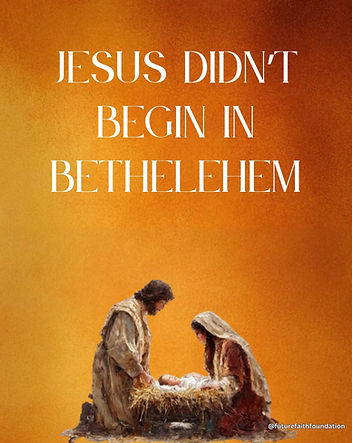
Jesus is not merely a man who began His life in Bethlehem. He is the eternal Son who took on flesh.
In John 8:58, Jesus deliberately says, “I am,” and the response of His hearers shows they understood the weight of His claim. They picked up stones to throw at Him.
Jesus was not presenting Himself as merely another prophet or teacher. He was revealing His divine identity. The One standing before them had existed before Abraham.
This is why who Jesus is matters so much. Christianity is not simply about following the teachings of a good man. It is about knowing and worshipping the eternal Son of God who became flesh for us.
Read John 8:48–59 and ask yourself: Who does Jesus say He is?


Hebrews 1:3 gives us one of the clearest descriptions of the deity of Christ in Scripture. Jesus is not a created being who became exalted, nor is He simply a man who reflects God better than anyone else. He is “the radiance of the glory of God and the exact imprint of his nature.”
The Son shares the very nature of God. He is distinct from the Father, yet fully divine. This is why Christianity cannot reduce Jesus to a prophet, teacher, example or messenger. The One who came in the flesh is the eternal Son of God. He created and sustains all things, reveals the Father perfectly, and is worthy of the worship that belongs to God alone.
“Christ” is not Jesus’ surname.
Jesus was not born into the “Christ” family. In the New Testament, Christ is a title. The Greek word Christos means “anointed one”, corresponding to the Hebrew Mashiach, or Messiah.
So when we say Jesus Christ, we are essentially saying Jesus the Messiah.
That matters because “Messiah” is not just a nice title. It tells us who Jesus is and what He came to accomplish.
Throughout the Old Testament, God promised that a coming King would save His people, establish His kingdom and fulfill God’s promises. The prophets spoke of Him, and Israel waited for Him.

When Peter confessed, “You are the Christ, the Son of the living God” (Matthew 16:16), he was not simply saying, “You are Jesus.” He was declaring that Jesus is the promised Messiah.
Jesus is the Christ.
He is the One promised throughout Scripture. The King who came to save His people from their sins. The One who suffered, died, rose again and now reigns.“Christ” is not His last name.
It is a declaration of who He is.

Acts 2:36 does more than identify Jesus as the promised Messiah.
Peter declares Him to be Lord and Christ.
Jesus is not merely a man chosen by God or a prophet sent by God. He is the divine Son who came in the flesh.
The New Testament consistently places Jesus within the identity of the one true God while still distinguishing Him from the Father. He is worshipped, forgives sins, receives divine titles, creates and sustains all things, and shares the glory of God.
Jesus is truly man, but He is also truly God. His deity is not something added to the gospel. It is at the heart of who Christ is.
The Bible teaches that the Holy Spirit is not simply a power Jesus uses. He is a divine person who teaches, speaks and glorifies Christ.
Jesus promised that the Father would send the Spirit in His name (John 14:26), and after His resurrection and ascension, Jesus poured out the promised Spirit upon His people (Acts 2:33).
The Father, Son and Holy Spirit are distinct persons, yet there is only one God. Jesus did not become God when the Spirit descended upon Him at His baptism.
He is the eternal Son who became flesh (John 1:1, 14). The Holy Spirit is fully God, just as the Son is fully God. This is the biblical foundation of the doctrine of the Trinity.


“But He was pierced through for our transgressions, He was crushed for our iniquities; The chastening for our peace fell upon Him, And by His wounds we are healed. ¶He was oppressed and He was afflicted, Yet He did not open His mouth; Like a lamb that is led to slaughter, And like a sheep that is silent before its shearers, So He did not open His mouth. By oppression and judgment He was taken away; And as for His generation, who considered That He was cut off out of the land of the living, That for the transgression of my people, striking was due to Him? ¶But Yahweh was pleased To crush Him, putting Him to grief; If You would place His soul as a guilt offering, He will see His seed, He will prolong His days, And the good pleasure of Yahweh will succeed in His hand. Therefore, I will divide for Him a portion with the many, And He will divide the spoil with the strong; Because He poured out His soul to death, And was numbered with the transgressors; Yet He Himself bore the sin of many, And interceded for the transgressors.”
Isaiah 53:5, 7-8, 10, 12 LSB
Jesus was not an afterthought in God’s plan of redemption. From the promise of the offspring who would crush the serpent in Genesis 3:15, to the promised King in David’s line, to Isaiah’s suffering Servant who bears the sins of many, the Old Testament prepares us for the coming of Christ. These passages must be read in their original context, but the New Testament shows us how God’s promises reach their fulfillment in Jesus.
He is the promised Messiah, the One who suffered for sinners and rose again. The whole story of Scripture points us to God’s redemptive work through His Son. Read Luke 24:25–27 and see how Jesus Himself explained the Scriptures in light of His suffering and glory.


The Christian life is not always easy, but we are not called to run this race in our own strength. When you feel weary, discouraged or tempted to give up, fix your eyes on Jesus.
He endured the cross for the joy set before Him, and He is the One who sustains and perfects our faith. Your hope is not in how well you perform, how strong you feel, or how perfectly you walk. Your hope is in Christ, who has finished His saving work and reigns at the right hand of the Father.
Keep going, not because you are strong enough on your own, but because Jesus is worthy of your perseverance and faithful to carry His people to the end.
From the promises of the Old Testament to the fulfillment of redemption in Christ, God has been working out His plan to gather a people for Himself. Jesus gave Himself for us “to redeem us from all lawlessness and to purify for himself a people for his own possession” (Titus 2:14).
Think about the beauty of that truth. Jesus did not simply come to make salvation possible. He came to save His people from their sins, to reconcile them to God, and to make them His own. Our salvation is not something we earn, but a gift of grace that transforms the lives of those who belong to Him.
We are part of something so much bigger than ourselves. One day, people from every tribe, tongue and nation will stand before the throne, worshipping the Lamb who was slain (Revelation 7:9–10). You were saved for His glory, to belong to Christ and to live for the One who gave Himself for you.
